Spring, interrupted…

IMG_4000.JPG
5 days on, and still plenty of lying snow around the monster’s perimeter

It has been a thoroughly grey and wholly sunless 5-6 weeks since February 1st, and to compound the hopes and expectations of all early growers and sowers, we here in Ireland, as with our neighbours across the pond on mainland Britain, have just experienced our harshest and heaviest winter snowfalls in over 35 years. Today, some 13 days after it ceased snowing there are still large drifts and clearance mounds right across the country.

In like a lion, out like a lamb” the old saying goes, and March certainly roared into the gardening year on this occasion.

This coming weekend brings on our national holiday, St. Patrick’s Day, a date by which many gardeners like to have established their broad plans for the coming spring, and traditionally the date on which many allotmenteers set the first potato drills of the year; but I think we’ll delay things a little this year. A lot of ground is still too sodden and very cold from snow-melt and run-off, and as hardy as some of our modern spud varieties may be, they don’t come supplied with accompanying life-jackets…

So, as with many other allotmenteers and kitchen gardeners right across Ireland and Britain spring activity on monsterinthecorner is most definitely interrupted this year; another week or two at the drawing board and in the potting shed, drinking milky tea and listening to Lyric. The seed onions have succumbed, dampening-off en masse so, we’ll go, and sow again. We’ll also go purchase the Celeriac and Kohl Rabi seed we meant to purchase but had, hitherto, forgotten to, and we’ll also add a little more organic material to some areas to compensate for the flooding leach-off…

So, another week or two of chitting, and wit-pitting against nature’s surprising elements; another fortnight to get it right; another fortnight waiting for the greenlight, and a favourable rise in fahenheit, another fortnight waiting till the risk of frostbite is out of sight; another fortnight to reset the solent wight; a fortnight to resow the gardener’s delight; another fortnight to just sit tight, knowing that with many weathered March things are never ever black and white, and that the early days of spring are never watertight.

Another fortnight, waiting for the lamb to slight the lion.

To Sow, and Not To Sow…

Reticulated Irises
Reticulated Irises 2018

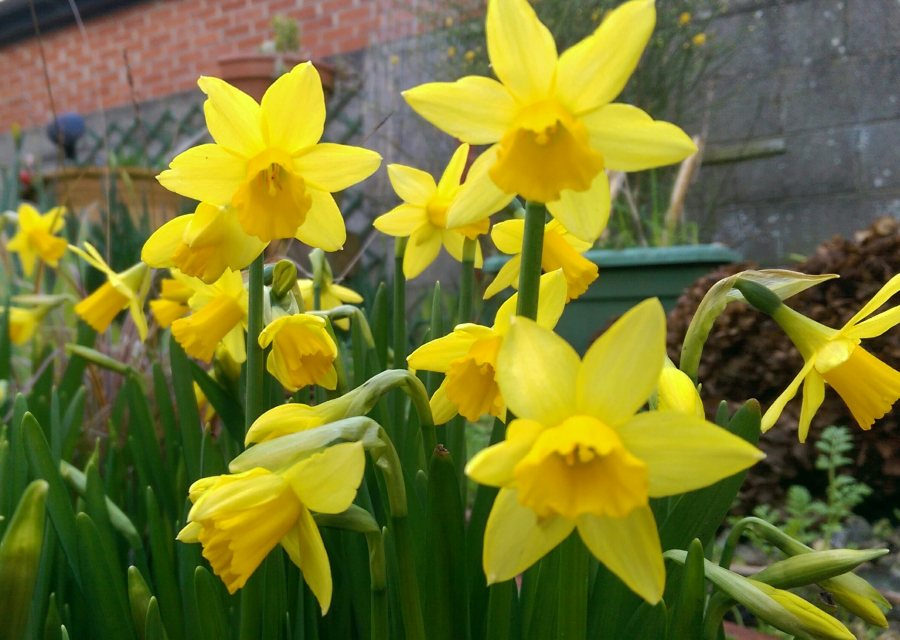
The snowdrops are showing; reticulated irises have brightened in glorious patches the last week or so, but the daffodils? The daffodils, being totally narcissistic, seem to be taking their own sweet time, though with that said, yesterday one or two of the Tete-a-Tetes finally put their radiant trumpets on public display.
It has been a thoroughly Irish winter, and one that lived up to the Irish gardener’s seasonal expectation. With the exception of two slightly milder days this past weekend, it has been a long, wet and chilly period of hibernated-vernilization since the last week of last November. Things however seem to be turning. There is a little more light to the end of each day, but with the constant cloud cover the benefit as yet is not fully appreciated. The temperatures are still a little below normal for this time of year, which means that taken together with the low light levels we have the classic combination that very often conspires to undo the early undertakings of eager seed sowers. Many a gardener’s desire to get ahead of the posse by sowing seeds as early as they can often proves a redundant exercise with the experience of dampening-off. This is what occurs when seeds that are sown too early in the season either refuse to germinate, or else having germinated – often sporadically so- decide conditions are not yet tolerable enough to make the effort for. Seeds that are left standing in cold damp compost too long end up with root rot, eventually laying themselves down en masse, adding their inchoate transparent leggy stems and cotyledons to the dank dark medium which gave rise to their brief green existence.
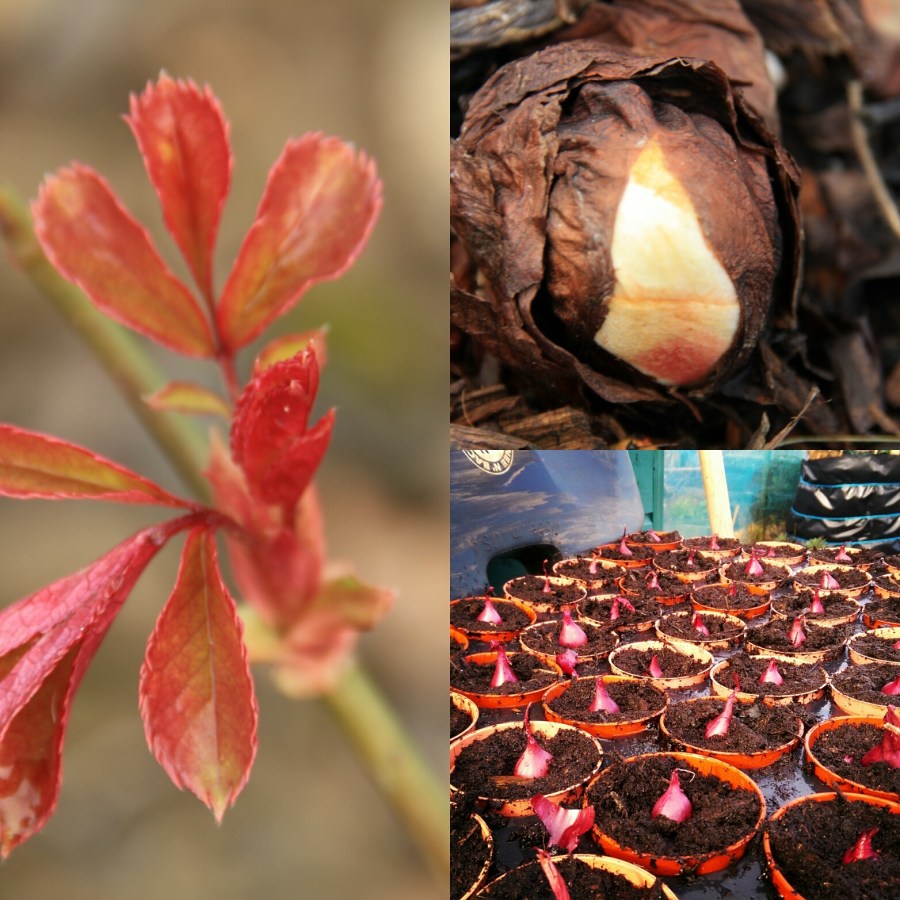
But, there are signs that things are a turning. The rhubarb stools are putting out new petioles; the pruned rose bushes are displaying delicate bright orangey-red flags; the garlic which seemed to have stood still since mid December is stretching ever so slightly at last; the parsley pots are greening up more than yellowing down and allium snouts are poking through the heavy damp clay. Perhaps it is just wistful thinking but there also seems to be a noticeable increase in birdsong from the hedgerows.
Despite the ancient Celtic Imbolc quarter day observance it is not quite spring. The milk may be flowing in the belly of the ewe, but there is a sting or two to the winter’s tale and tail yet. Mindful of all we have just said, we did nonetheless make some tentative progress this last weekend. Being a little more tolerant of cooler sowing conditions and not being quite as finicky as their allium cousins we put some red shallots into one of the raised beds. We also strew two small trays of zinnias and marigolds, while at home we popped some Rosa Blanca aubergine seed into a pot for a south facing windowsill. We filled some starter pots with compost and popped red baron onion sets into the polytunnel, and finished off by covering a few Nero di Toscana kale seeds, as they’re also cool weather tolerant.
The trees have been pruned and where and when required they were washed. The monster’s bolt hole has been tidied; all pots and trays are clean and good to go; seeds and sets have been sourced and sorted and whatever could be done during the darker wetter days was done. Things are drying up, slowly. The badgers are on the move; with little or no ground cover left for camouflage at winter’s end the hares are more skittish than usual, and today crows could be seen making the most of seasonal casualties, gathering and relocating winter fallen twigs to the still naked canopies of the oaks and beeches.

wp-1519222444959..jpg
New rhubarb petioles, Red Baron onion sets and new rose bush growth

We’re not there yet, but we are getting there.

Softly, softly still though, not too far ahead of the posse should you go.  And in deciding whether to sow or not to sow, remember that the surest course to no carrots and beetroots for harvest is to sow them now.

Tete-A-Tete Daffodils
Tete-A-Tete Daffodils 2018

When The Weather Clears

The days are dull, dark and damp. It is most definitely mid January and unmistakably deep winter. The Christmas decorations are once again consigned to attic or shed for the next 11 months, and the New Year’s celebration bubbly bottles have been emptied and recycled through the local bottle banks. Something which only a few short days before still held a certain charm and relevance can suddenly find itself out of place and out of time once its sell by date is reached, and once Christmas’ celebrate by date is passed, it is definitely passed. That which was full of bright promise in the latter days of December can seem abruptly garish and jarring just these few short January days later.
I suppose when it’s time to go, it’s time to go.

The same of course must be said of things here on monster in the corner. No longer can we say that we are working our way through the first year on a new plot. Everything we said we had planned to relocate in the moving to our new plot was relocated, and everything we said we had hoped to sow and grow on that new plot was actually sown, and thankfully most of it grew as expected. This time last year we set ourselves some new year’s tasks and we experienced quite some pleasant success when late last August monsterinthecorner was awarded the prize of Best Overall Allotment 2018 at the annual awards. So no longer can we say that we are only in our first year for we are not, and in all truthfulness the monster is now well and truly established at its current location. When it’s time to go it’s time to go, and last year was last year; and that was then and this is… well, now.
The monster’s new year begins midst squally, sleety, stormy weather (in stark contrast to its beginning at this time last year) and where the last three years saw us experience relatively mild and generally uneventful winters, this year the winter season is providing us with plenty of weather.
In a posting from a frosty November morning just as this season was setting in we wrote that perhaps, if we were lucky, we would get just such a winter; noting that a little sharp vernilization in general, is a good thing for the kitchen garden.

So, reminder to self…be mindful of what you wish for!
It has been a very wet and notably cold winter to date, and once more this week we are subject to influences of large polar maritime air masses which seem set to dominate things again for the next seven to ten days. Regardless of how mild -or otherwise- any given winter can be, according to Long Term Average analysis the coldest period of Ireland’s winter season is from mid January to mid February, and it would seem all is right on cue.
With winter truly bearing its teeth this year, there is little that can be done on the allotment. Any attempt to turn or cultivate growing areas will backfire spectacularly, and any pruning which needs to be done and hasn’t yet been done is best long-fingered till things at least dry up a little. There is still ample time to shape and coax next year’s fruiting spurs and blooms from the present dormancy, and where cold weather pruning is par for the course, it’s best done during a dry period to minimize damage to newly exposed wound wood by extended exposure to wet conditions.
Other jobs for the allotment at this time of year are the standard housekeeping requirements for all gardens and plots and are, and have been, well documented over the decades. There are however one or two activities that can be undertaken now which are not so weather dependant and these are some of the gardening year’s gentler activities. While waiting for the weather to clear you can busy yourself perusing the gardening supplements and seed catalogues which suddenly seem to be arriving two-a-penny with every weekend newspaper, offering hints and tips together with design and advice to amateur and professional alike on everything from soil nutrition and pond depth, the latest must have celebrity endorsed tools, to current developments in Hydroponics and what it is that you simply must do now to ensure bigger, better blooms and harvests later in the year. All standard commercial fair mind you, aimed at planting that persuasive seed of need into your plans in the hope it will germinate in your pocket or purse. Or you may, if you wish, undertake something that we here do annually before the gardening season gets under way in earnest. About this time every year we at monsterinthecorner take out our seed storage box to examine and inspect the contents. It is a curious exercise sifting through the packets and envelopes and recalling what it was we had originally plotted to do the previous year. There are always a number of wallets and pouches that will have remained unopened and as such unused, and it is often puzzling trying to remember why we never followed through with the plan that made us buy them to begin with. But, we suspect most gardeners have such a box of curious perplexities. Of course, having opened the box it then becomes necessary to assess the viability of its contents, and this is where you need to be ruthless. Fresh seed looses its viability over time and the process of degradation is speeded-on once the original storage packet has been opened. How long seeds are likely to retain their viability largely depends on two things: the seeds own inherent shelf life, and secondly how they are stored once packaged. Moisture and unnecessary heat are two of the main conditioners contributing to seed deterioration, and seeds last longer if stored in a cool, dry environment. Nonetheless, regardless of how you store them some seeds naturally last longer than others: parsnips, celeriac and parsley will not last much longer than one year; whereas peas, tomato seed and some beans can remain viable for over a decade. Most leafy vegetable seed should last for at least 5-6 years; beetroot and radish for 3-4 years while carrot, turnip and swede seed will last for 2 years if you’re lucky. By and large this is in line with our own experiences over the years of sowing and growing, and though we’ve only outlined vegetable seed here, much the same storage guidelines apply to bloom and meadow seed as well, although with that said, it is generally accepted that a lot of flower seed has a much longer shelf life than most kitchen garden seed.
And so once again we’ll pop the lid on our seed treasury chest and we’ll scrutinize. We will examine the remaining basil seed purchased in Malcesine 4 years ago, the beans and sunflower seed sourced by the Dirt-Digging missus herself in Toulouse 3 years ago together with the beans and pumpkin seed brought home from Toronto in August 2016. It’s something we do while on our travels, a potential living memento of our foreign excursions should we be lucky enough to get them to germinate and grow in our home clime: some warm sun-filled reminiscences to help buffer January’s dreary days. We’ll also need to check the condition of the foraged poppy, sunflower, pumpkin and cosmos seed collected from the monster’s own beds and borders last autumn.

And then we’ll wait; wait for the weather to clear; wait till there is not so much weather about; wait till we can get out and about once more and the monster’s ways are trafficable enough to allow us empty some of those packet contents into pots and trays and beds and get the whole process under way once again; but, only when the weather clears.


That Time Is Now…

This Week last year the monster was in flux:

January 2017 saw monsterinthecorner begin the arduous task of relocating all stock and holding to a new allotment plot some five miles away from its established site. We speculated then what the coming year would bring, and whether we would be capable of rising to the challenges of starting again from scratch on a new plot, in the depths of winter. We postulated then that the monster would be completely transformed by the same time next year, and that we would relish the transformative process and our part in it.  Yet little did we realize just how much we could, and eventually would, achieve.

One of the very early postings from our new stomping ground last January was titled     By This Time Next YearSo, by way of  follow-up the best we can say is that  That Time is now…
We could have –indeed should have– posted many more updates during last year, but as you’ll appreciate we got busy doing as we had quite a lot to do, and it was no mean task to cultivate a totally neglected and overgrown large allotment into a prize winning kitchen garden plot, and to do so in the space of 25-30 weeks. We had many hours of wonderful fun; we’ve made some wonderful new friends and acquaintances, and mostly we learned to relearn all we formerly thought we knew about allotmenteering.

Of course, as the overall prize winning allotment last year monsterinthecorner has, (as many of our new neighbours are constantly and good-humouredly reminding us) set the standard not only for others, but also for ourselves in the seasons and years ahead. And who knows? with our template now well and truly settled after a frenetic first year, perhaps ( just perhaps) we’ll have a little more time to cultivate here as well.

Monsters montage
the monster’s montage from year one at the our new stomping ground

A very happy New Year to all.