
Tines, tangs, eggplants and elephants.

Suddenly it is here, and just as suddenly it is now

Christmas and New Year are come and gone; January’s blues are finally usurped by February’s lengthening days, and by way of added bonus this year we get to celebrate a brand spanking new public holiday right here at the beginning of February: Lá Fhéile Bride; St. Brigid’s Day.

Although this 1st day of February has always held a special cultural significance, and on many trains of thought is considered the first day of the Celtic spring not only here in Ireland but across many parts of north-western Europe, it is only here, this year, that the day itself has been officiated as a national public holiday and placed on a par with St. Patrick’s Day.

So it is that the milk once again flows in the bellies of the ewes; snowdrops, though tiny are gleaming white, catkins dangle as blue tits check out nesting suitability of every nook and cranny and the first of the daffodilly golden trumpets have unfurled, heralding, if not the arrival of spring, then perhaps at least that winter’s end is not too distant now.                    

But February being February, often hides a wintry sting in its tail.

The monster’s measure was kept ticking-over during the darker days. Drills and raised beds were cleared and covered before midwinters with running repairs to gate-posts and fence-lattes carried out as needed. Empty pots were rubbed and scrubbed, and tools were put under cover.

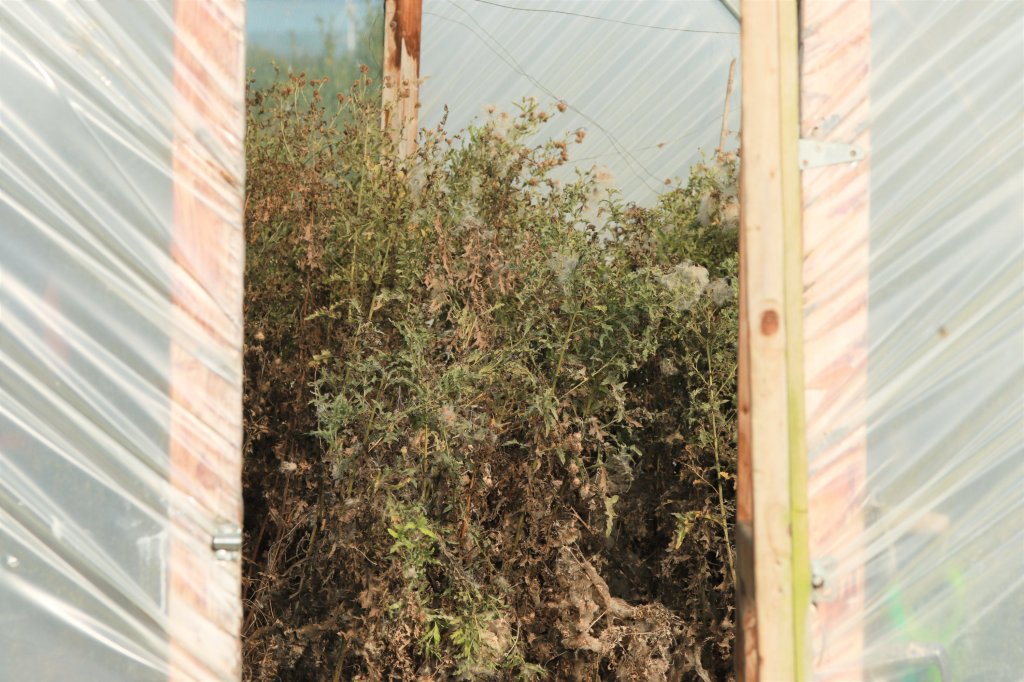
The measure increased somewhat at winter’s end with the acquisition of an overgrown and sadly neglected polytunnel that sat unused at the end of the allotment site these last number of years. This twenty-foot-long eyesore has kept us more than busy with the clearance of its crop of six-foot-high creeping thistle from every square inch. It was a challenge, and it has been a minor achievement to make notable progress, and so hopefully come April-May it should have a totally new aspect.
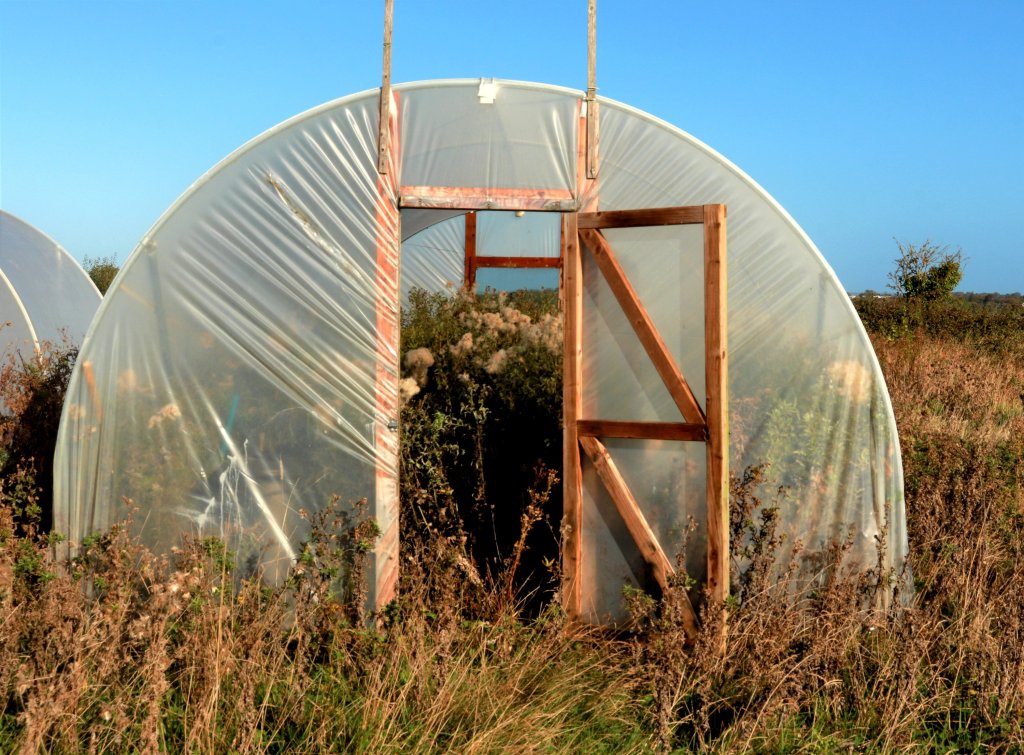
Winter can be a challenge to any gardener, from the backyard potager to the large estate manager there is much to do in preparation for that which the winter season brings to the garden.  Many tasks need doing to make sure the garden pulls through in some semblance of order once winter passes.  But with that said, an acknowledgement also that the dark season must be allowed to do what it does best: vernalize.

Though winter can be daunting to the gardener, there are few things more disheartening and demoralizing to the allotment gardener as the totally dilapidated aspect of a large allotment site during the winter months where many plots are purposely allowed go to absolute wrack and ruin: acres of rotted timbers, mangled netting, falling down knock-me-up-sheds and rusted homemade cloche frames; wheelless barrows, tineless forks and tangless hoes.   This seems to be a specific peculiarity of the Irish and British Isles allotment sites for we’ve not experienced this level of expected and accepted horticultural neglect elsewhere, and we have visited allotment sites in many other countries and continents.  It is as if site management will accept anything so long as the income stream is maintained. And so as long as annual rent and con-acreage stipend is paid well then you can grow and sow as you please, or simply create a plotted blot for the allotment landscape, with impunity, so long as you renew your lease. Although everyone else can see it staring them in the face (and although some allotment sites do not allow livestock), no-one must mention this particular elephant haunting the allotment sites. Everyone pays their money and you learn to work with what you get, and should such elephants be always named Abandonment well so be it,

However, back to allotment future with focus firmly on the monster’s own measure this year’s sowing diary is started:  Ailsa Craig and Bedfordshire Champion onion seed are sown under cover since the end of January.  We also sowed some salvia seeds ‘Victoria Blue’ along with some foraged Salvia Atropatana seed compliments of the National Botanic Gardens last October, and today we got to put Moneymaker tomato seeds into modular trays; once again under cover.

 Last week a neighbouring plot-holder kindly gifted us some Aubergine seed. Returning from Portugal before Christmas she purchased a packet of Aubergine seeds for £1.09. the pack containing upwards of 2000 seeds. A pack of 12 Aubergine Seeds averages £3.99 in most high-street garden centres in our fair city. Wow! And as most are selectively blind to Colonel Hathi’s troop on the dilapidation of allotment sites perhaps it would prove redundant to attempt to draw attention to Gajjini or Hathi Jnr on the shop shelves. But a bargain is a bargain, with thanks to our neighbour. We’ll leave that particular jungle to another day.

Spring beckons: green fingers and grubby nails await. Mrs Dirtdigger has been removing thistle root inch by inch and by week’s end we should be re-assembling the polytunnel grow beds in good time for the off come first week of March. Winter has been long but we remember that February is the shortest month. We have packets of seed and packages of bulbs to set out and sow; sets to start and tubers to chit. The seed chest is full to overflowing, and they won’t grow in the packets; time to move the diary on we thinks, but mindful still of the lingering chill in the early February air.
Many Weathered Madness

it has finally, finally dried out, and we’ve been able to get onto the monster’s measure. So we’ll be updating over the weekend, in the meantime a few pictures taken over the last number of days…

We’ve managed to build our replacement beds, and get our broad beans, parsnip seed and onions sown, so suddenly we don’t seem so far behind schedule.   We’ll be updating the sowing diary also to reflect what we have sown to date.  And so after have lying water on our plot for almost 10 weeks we once again have terra firma to work and cultivate… 

A Monster Midsummer in Dublin and Lille…

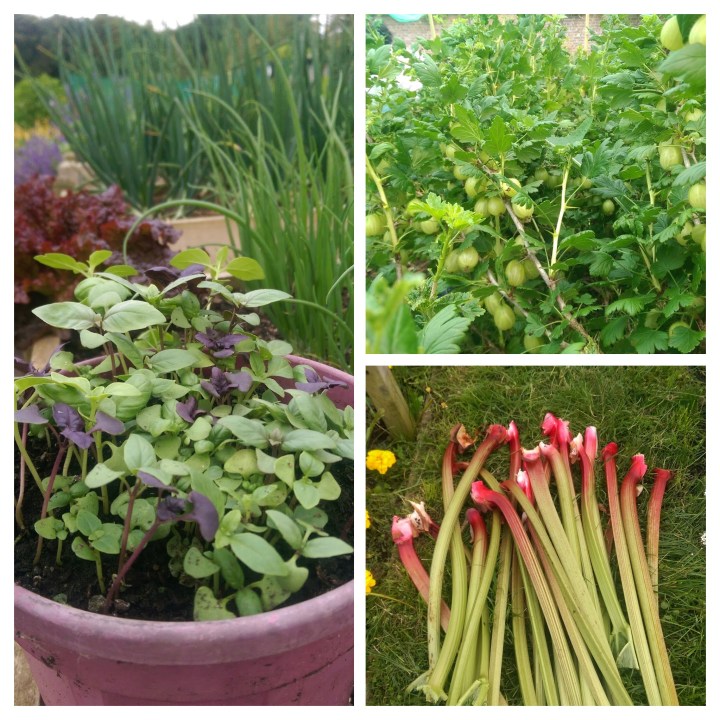
Basil Gooseberries & Rhubarb

Chelsea, Chatsworth and Malvern have come and gone, as has Bloom in the Park, and gone too are all those plans we had at the beginning of the month to make postings on all the aforementioned festivals and events. June arrived and on its tails came the air of summer with all its latent promise: warm bright days, summer festivals, ál fresco lunches in short-sleeves and daily blight warnings.
We’ve made busy on The Monster in the Corner, so much so we actually lost ourselves in the doing of things on the plot, and it is only now that we have all things bedded, supported, weeded and netted that we have the time to recap and sketch out the late summer and autumn plans and finally post them here.
All of the plot’s beds are flourishing: the gladiator parsnips are growing very well and now that we’re at mid-summers the Centurion and Stuttgarter onions are finally beginning to bulb but, as expected, about one in six has bolted. The Karmen reds, not surprisingly, are still lagging behind but all the summer bunching and salad onion are now ready for use. We’ve been pulling rhubarb stalks on each visit to the allotment and have jammed and jarred the first flush glut with some finely grated stem ginger. This store never lasts very long as it’s generally shared with extended family, friends and work colleagues, but the Victoria stools seem to be sprouting well enough yet and we should have ample for further desserts, crumbles and that second flush glut for more jam.
The shallot tips are beginning to colour down so these shall be rudely unearthed in the next fortnight or so. A great deal of effort the last 3 weeks has been spent battling the squirrels, blackbirds and magpies for ownership our rapidly ripening blackcurrants and gooseberries. We’ve always acknowledged foregoing nature’s share, but there’s only so much we’ll allow the wildlife to covet.
Having decided against a strawberry crop the last three summer seasons this year we planted up a small bed of 20 plants (a new variety called Malling Centenary) and we’ve had some of these. As with all first year crowns, the pickings were slim, but the berries themselves are of a very good size with that great taste of summer…
The early sown radishes, lettuces and rocket have gone over, so we’ve made more sowing for later in the summer, and the first beetroot sowing is just about ready for some baby-beet pickings. The Broad beans were well and truly walloped with black-fly, and on more than one occasion, this no doubt down to the warm and humid conditions which proliferates their spread, but that said we have fared better than the other plot holders across the walled garden whose potato crops have all been badly decimated with blight. The red Kale sown in May has now been planted into the open drills, as have the pumpkin and ornamental courgette plants, and as usual the herb and floral border which is one of the main focal points of the Monster in the Corner is once again in full bloom and generating the annual conversation piece with the passers-by.
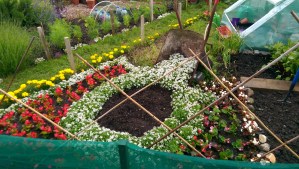
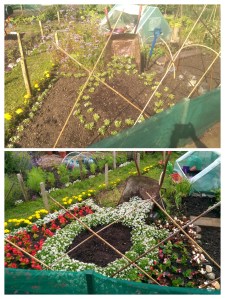
We’ve decided to change the Monster’s ‘rude mechanical’ this year. Since first beginning work on the allotment our ‘play’ has been a large chestnut log with bug hotel and carved wooden plot number in situ. But given the effects of three wet and stormy winters it was looking a little forlorn. This year we’ve gone for a spilled-barrow effect; a living mechanical if you will, the Monster’s designation and number in living floral form. Originally conceived in red, white and bluegiving a nod to the EURO’s 2016 event in France- we’ve adapted a little at the last minute to facilitate incorporating another of the elements of the walled garden into the design, and with a little luck we should be putting the finishing touches to it over this coming weekend.

The Monster's Mechanical Spilled Barrow almost complete
The Monster’s Mechanical
Spilled Barrow almost complete

Almost Completed...
Almost Completed…

Madame dirtdigger is somewhat incapacitated at present, but there’s no slackening-off with this particular one armed weeder & feeder; still showing up for plot duty, still making the most of the weather, and reminding me that as of today the days are no longer stretching. Today, and for another day or so, the season’s daylight is fully taut. Midsummer’s mindfulness abounds, filled with birdsong dawns and those slow receding half-light dusks stretching almost to midnight; young starlings learning the principles of murmuration formation flying and beech nuts and hazel nuts now setting on the branches; cosmos, lilies and lupins beginning to open; sunflowers reaching into the broad light with basil and coriander pots scenting the plot and the outdoor courgettes showing signs of bloom…and to top it all off, great sporting nights like last night that will live long in the memory as the low lying fields of Athenry worm their way into the French psyche’s  association with the Green ArmyCOYBIG

The Green Army doing what they do best...
The Green Army doing what it does best…


Robbie's Italian Job
Robbie’s Italian Job

robbies-goal.jpg.jpg
Robbie Brady’s goal…

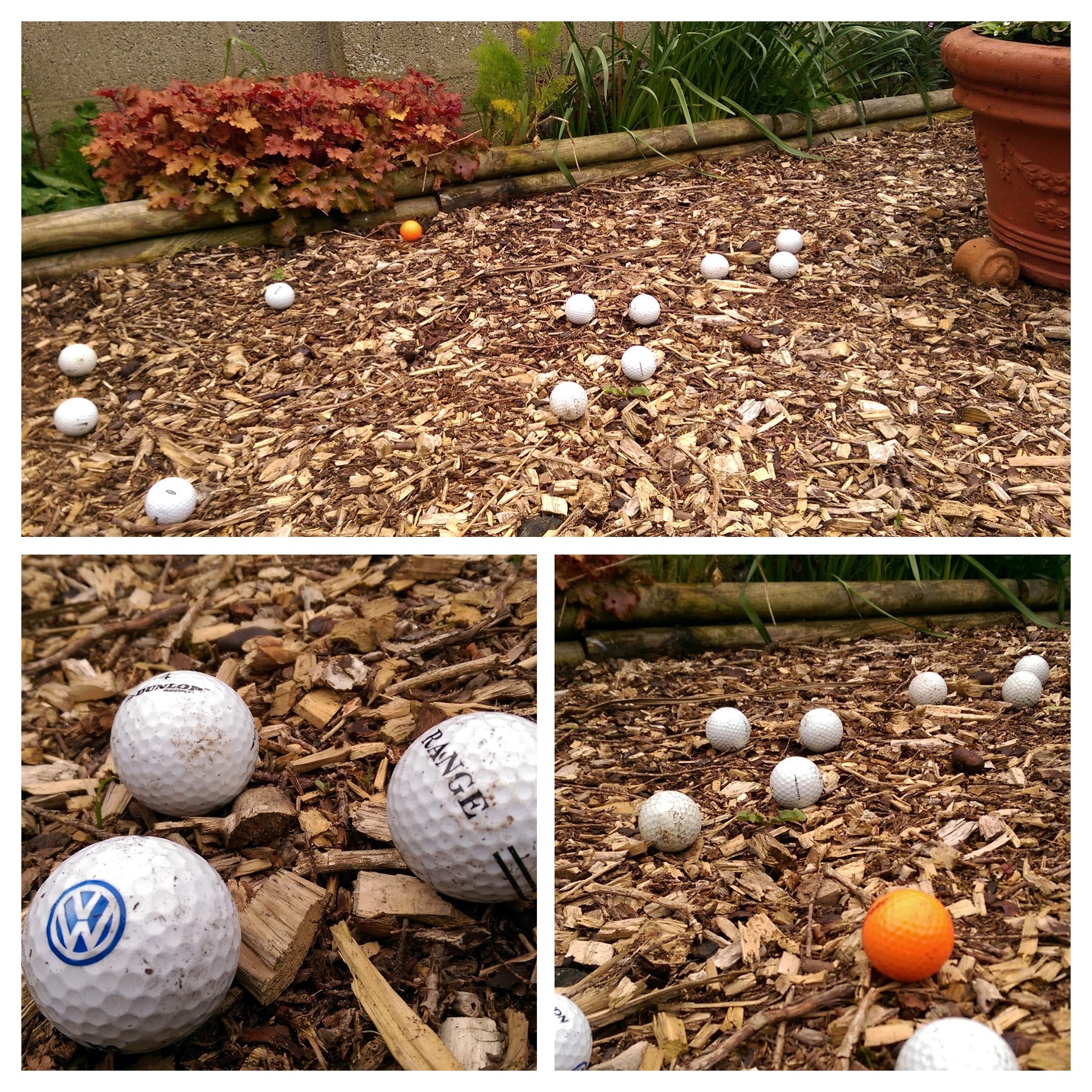
The Dimpled Golfus…Strange Fruit.

Golf Balls 2016
The Dimpled Globulus Golfus. Strange Fruit Indeed.

Yesterday evening, we here on Monster In The Corner hosted the first of this year’s open events. Each year we endeavour to facilitate local gardening associations and interest groups wishing to have a look around the walled garden. Over the years we’ve accommodated local schools and Girl Guide troops, scouting and Sunday school groups and the local herbalist society. Each year we also receive requests from local associations and branches of the GIY (Grow It Yourself) organisation.
GIY began life as a network of gardening and allotment enthusiasts dedicated to growing their own food. It quickly became a national network and recently has reached out to become an international organisation. It is a not-for-profit network with over 50,000 people currently involved in 800+ community food growing project groups that in recent years has gone from strength to strength.
Last year we received a request from the Raheny GIY group to allow it peruse the walled garden, and yester-evening we were happy to host the Clontarf branch GIYers.

For many of that group it was their first visit to an allotment garden, and I think it is fair to say that by the end of the 90 minute tour some of the questioning curiosity and keen anticipation was more realistically grounded than it had been when they first entered the garden. Although gardeners themselves, the GIY group’s misconceived vision of allotment life was certainly jolted, but that is not to say they were not impressed with the allotment garden as a whole. I think the biggest surprise to the group was the amount of un-worked and/or abandoned plots around the garden. We pointed out that we have just had the longest winter followed by a delayed spring.  We also drew attention to the fact that Life sometimes gets in the way of peoples’ desire to garden, and accounting for the fact that a lot of people take on an allotment without any idea at all regarding the level of commitment needed to maintain it, we told them that it is never surprising our allotment garden has an annual abandonment rate (like many other allotment gardens) of about 15%.
Overall the group enjoyed the experience and were fascinated by the vastly differing approaches used by the collective plot holders in working their respective plots. It was quickly determined that there are as many ways to garden as there are gardeners to garden, and never more so than in an allotment garden; raised beds, lazy beds, turned ditches, square foot planning and no-clear-spot-planting; buckets, barrels, barrows, baskets and boxes; recycled tubs and misplaced piping. Small plots, fallow plots, overgrown plots, recently sown drills, and not forgetting the Monster in the Corner, which we like to consider (with bias of course!) as one of the exemplars.
We were asked about growing mediums, and crop rotations; organic seeds and heirloom varieties; compost, leaf-mould, perennials and annuals; polytunnels and cloches, with pictures taken of anything and everything which caught the eye or was deemed click-worthy.
The group spent some time examining the Monster’s measure itself and all that is currently sown and   in-situ on our own plot.
We were asked about our favourite crops, our most challenging crops, our most dependable crops and our greatest failures.
Enquiry was made into the most exotic thing we’ve ever attempted to grow, and we reminded the group that exotic fruit and vegetables invariably need exotic climes in which to flourish, but that with the aid of a polytunnel you could, if you wished, attempt a venture with more exotic varieties, whereas to our mind a polytunnel is best served in simply helping to extend the growing season. We did say we had attempted Romanesco with some minor success, and Radicchio, again with minor success, Oca, Sunchokes and Samphire, but that we do like Celeriac, and not so much that it’s an exotic vegetable, it’s more that many gardeners don’t actually grow this fabulous gnarled root.
We then drew the group’s attention to the garden’s most exotic produce: the Dimpled Globulus Golfus.

The Dimpled Globe is a random free forming crop that suddenly appears on certain plots, and all the more so with any slight improvement in the weather. It truly is an exotic crop. The fruit appear as if by magic. No seed is ever sown, and neither leaf growth nor root growth ever observed. No drills need be prepared and no weeding ever needs to be carried out. Curiously, no watering is ever needed to sustain the crop; in fact is has been noted that where all other crops thrive after a downpour of early spring rain, this particular crop disappears until the weather improves. It is as if the whole staggering 800 million year evolutionary development history of the flora world is instantly perfected in the blink of an eye, and these dimpled fruit-lets appear without any effort at all. Tah Dah!
They are sun-proofed and water resistant and hard as the hammers of hell and wholly inedible. The cultivar is predominantly white, but mutations and variants luminously coloured yellow and green and orange have also been seen. This predominantly summer occurring crop is a constant source of fascination to everyone.
No-one ever sows them, and yet there is this steady and constant seasonal supply.

No-one knows for sure where these strange Globes originate but legend says that these come from beyond the walled garden’s walls, where another and altogether stranger world exists. There are some here who claim to have heard strange incantations from this other world just before the appearance of the Globulus Dimplex, and on certain still and quiet days feint echoes of this distant invocation will be caught drifting on a summer breeze: Fore! Fore! Fore!…
Last year the plot holders  managed to harvest over 460 of these during the summer season, and we then sell them back to the local Pitch-and-Putt clubhouse: a bag of ten fruits for Eur2.00…no best before date, no sell by date, and no refrigeration needed.  What a bargain eh!
And Oh! how our visiting groups love to take home some of this strange, strange fruit.